

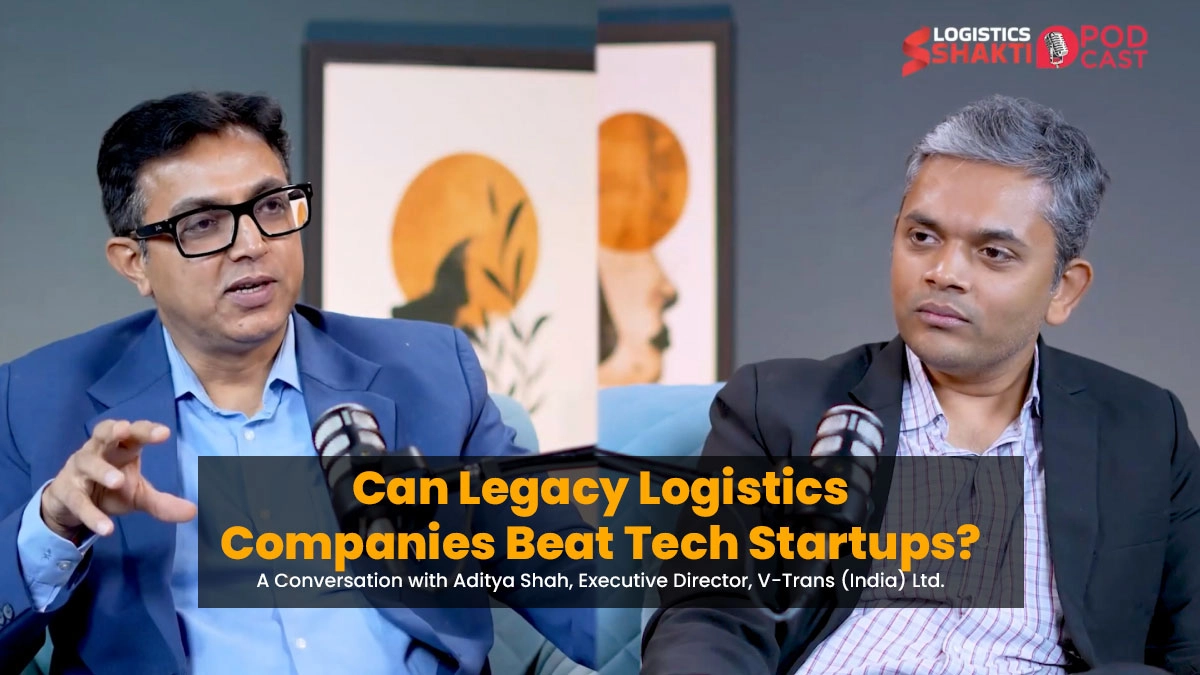
Insights from the Logistics Shakti Podcast on scaling a ₹2000 crore enterprise.
The Indian logistics landscape is undergoing a seismic shift. In a recent episode of the Logistics Shakti Podcast, host Amit Shankhdhar sat down with Aditya Shah, Executive Director of V-Trans (India) Ltd., to explore how legacy companies are navigating this new era of technology and disruption.
The story of V-Trans is a testament to resilience and strategic evolution. Founded in 1958 with just a single truck, the company has grown over six decades into a massive logistics powerhouse valued at ₹2000 crore. Today, V-Trans has evolved far beyond its roots as a simple transport company, transforming into a multi-vertical giant that offers Full Truck Load (FTL) and Part Truck Load (PTL) services, express logistics, 3PL solutions, and specialised supply chain fulfilment for the e-commerce sector.
One of the most compelling segments of the conversation centred on the competition between traditional logistics firms and modern, tech-driven startups. Aditya Shah provided a nuanced perspective on why “legacy” isn’t a disadvantage but rather a foundation for innovation. The winning strategy, according to Shah, is not choosing between technology and tradition, but successfully balancing corporate legacy with modern innovations. While startups bring agility and digital-first mentalities, legacy players bring deep-rooted customer relationships and operational wisdom that provide a stable platform for growth.
For logistics leaders looking to navigate this landscape, several key takeaways emerge from the V-Trans journey. First, technology adoption is non-negotiable; legacy businesses must modernize to stay competitive, using digital tools to enhance rather than replace their core values. However, these tools must be balanced with strong, trust-based customer relationships, which remain a critical differentiator that technology alone cannot replicate. Furthermore, sustainable growth is essential, requiring companies to scale operations without over-leveraging the business. Finally, mastering operational dynamics—such as understanding the distinct efficiencies between surface express and air cargo—is vital for successful diversification.
Ultimately, the future of transportation in India belongs to organisations that can successfully blend trust, human relationships, and operational excellence with digital transformation. By integrating these foundational elements with technology-driven innovation, companies can achieve long-term success in an increasingly crowded market. To dive deeper into Aditya Shah’s insights on modernisation and sustainable scaling, you can watch full episod here.